



Club Safeguarding Policy for Percy Park Rugby Football Club
Chris Bolam
+44 7484 781491 (M)
Safeguarding Policy
1. Percy Park Rugby Football Club acknowledges its responsibility to safeguard the welfare of all children involved in Percy Park RFC from harm.
2. Percy Park RFC confirms that it adheres to the Rugby Football Union's Safeguarding Policy and the procedures, practices and guidelines and endorse and adopt the Policy Statement contained in that document and any successor policy.
3. A child is anyone under the age of 18 engaged in any rugby union activity. However, where a 17 year old male player is playing in the adult game it is essential that every reasonable precaution is taken to ensure his safety and wellbeing are protected.
4. The Key Principles of the RFU Safeguarding Policy are that:
· The welfare of the child is, and must always be, paramount to any other considerations.
· All participants regardless of age, gender, ability or disability, race, faith, culture, size, shape, language or sexual identity have the right to protection from abuse or harm.
· All allegations or suspicions of abuse, neglect, harm and poor practice will be taken seriously and responded to swiftly, fairly and appropriately.
· Working in partnership with other organisations, statutory agencies, parents, carers, children and young people is essential for the welfare of children.
· Children have a right to expect support, and personal and social development delivered by an appropriately recruited, vetted and managed in relation to their participation in rugby union, whether they are playing, volunteering or officiating in the community or professional areas of the sport.
5. Percy Park RFC recognises that all children have the right to participate in sport in a safe, positive and enjoyable environment whilst at the same time being protected from abuse, neglect, harm and poor practice. Percy Park RFC recognises that this is the responsibility of everyone involved, in whatever capacity, at the club.
6. Percy Park RFC will implement and comply with the RFU Code of Conduct and the Codes of Conduct for Coaches, Spectators and Officials as appropriate.
7. The Club Safeguarding Officer is Kevin Dale
8. If you witness or are aware of an incident where the welfare of a child has been put at risk you must, in the first instance, inform the Club Safeguarding Officer. They will then inform the CB Safeguarding Manager and the RFU Safeguarding Team. If an incident involves the Club Safeguarding Officer you should inform the Chair of Youth Rugby and either the CB Safeguarding Manager or the RFU Safeguarding Team.
9. All members of Percy Park RFC who work with children in Regulated Activity must undertake an RFU Disclosure and Barring Service (DBS) check in accordance with RFU Regulation 21.
10. Percy Park RFC will ensure that all its members, whether they are coaches, parents, players or officials will comply with the Best Practice Guidance as issued by the RFU. In summary, the following are NOT acceptable and will be treated seriously by the club and may result in disciplinary action being taken by the club, the CB or the RFU:
· Working alone with a child.
· Consuming alcohol whilst responsible for children.
· Providing alcohol to children or allowing its supply.
· Smoking in the presence of children.
· Humiliating children.
· Inappropriate or unnecessary physical contact with a child.
· Participating in, or allowing, contact or physical games with children.
· Having an intimate or sexual relationship with any child developed as a result of being in a 'position of trust.'
· Making sexually explicit comments or sharing sexually explicit material.
11. Percy Park RFC manages the changing facilities and arranges for them to be supervised by two DBS checked adults of the appropriate gender for the players using the facilities. [ ] RFC ensures that all its coaches, parents, officials and spectators are aware that adults must not change at the same time, using the same facilities as children.
12. Percy Park RFC will ensure that its coaches and team managers will receive the support and training considered appropriate to their position and role. The RFU "Managing Challenging Behaviour" Policy has been adopted and circulated amongst the club workforce both, voluntary and paid.
13. Any events held on Percy Park RFC premises must comply with this Policy and if appropriate a Safeguarding Plan should be discussed and circulated to those affected. Any tours, overseas or domestic, undertaken by Percy Park RFC must comply with the relevant RFU Regulations and Guidance relating to tours.
14. Any junior teams using social media to communicate with their players / parents should ensure they comply with the Northumberland CB Safeguarding policies that can be found on the Northumberland RFU website:
There may be a number of other points clubs may wish to add to this policy to take into account any matters which are specific to their club, ie if it is on a public site there may be additional safety issues. Clubs should not delete any of the above.
This must be adopted in accordance with the club constitution.
Percy Park Privacy Notice
Summary of how we and the RFU use your data
· Percy Park RFC uses your personal data to manage and administer your membership and your involvement with its teams and club, and to keep in contact with you for these purposes.
· Some data is shared with the RFU, who use your data to regulate, develop and manage the game.
· Data is not shared with any other parties. Communications may be made on behalf of a partner with Percy Park maintaining control.
· Where we or the RFU rely on your consent, such as any consent we seek for email marketing, you can withdraw this consent at any time.
· Amongst the data we collect from you may be medical (including injury) information. We will hold this where you (or your parent) have given consent, so that we can ensure we are aware of your condition and ensure that you are supported appropriately.
· Where you work in a particular role within the game, you may be required to undergo a Disclosure & Barring Service check using the RFU’s eDBS system. The result of this check will be input into your Game Management Service (GMS) record.
What does this policy cover?
This policy describes how Percy Park RFC (also referred to as “the Club”, “we” or “us”) will make use of the data we handle in relation to our members and players, including our use of the Game Management System (“GMS”) provided by the Rugby Football Union (“RFU”). The policy also describes the RFU’s use of data on GMS.
It also describes your data protection rights, including a right to object to some of the processing which we carry out. More information about your rights, and how to exercise them, is set out in the “What rights do I have?” section.
What information do we collect?
We collect and process personal data from you or your parent when you join and when we carry out annual renewals of your membership. This includes:
· your name
· your gender,
· your date of birth,
· your RFU ID (as assigned in GMS)
· your home address, email address and phone number;
· your passport, birth certificate, driving licence and NI details, which we have to collect as part of the DBS Disclosure and Barring Service (DBS) in order to check your eligibility to be involved at the club in a voluntary capacity (or a paid employee)
· your type of membership and involvement in particular teams, or any key role you may have been allocated, such as Chair, Safeguarding Lead, Membership Secretary etc.;
· your payment and/or bank account details, where you provide these to pay for membership;
· your marketing preferences, including any consents you have given us;
· your medical conditions or disability, where you provide this to us with your consent (or your parent’s consent) to ensure we are aware of any support we may need to provide to you.
Some information will be generated as part of your involvement with us, in particular data about your performance, involvement in particular matches in match reports and details of any disciplinary issues or incidents you may be involved in on and off the pitch, such as within health and safety records.
What information do we receive from third parties?
Sometimes, we receive information about you from third parties. For example, if you are a child, we may be given information about you by your parents.
We may receive information relating to your existing registrations with other clubs or rugby bodies or disciplinary history from the RFU through GMS. Additionally, for certain role holders or those working with children, we may receive information from the DBS and RFU on the status of any DBS check you have been required to take.
We may also receive information from your school in relation to any sports injury i.e. head injury
How do we use this information, and what is the legal basis for this use?
We process this personal data for the following purposes:
§ To fulfil a contract, or take steps linked to a contract: this is relevant where you make a payment for your membership and any merchandise, or enter a competition. This includes:
§ taking payments;
§ communicating with you;
§ providing and arranging the delivery or other provision of products, prizes or services;
§ As required by the Club to conduct our business and pursue our legitimate interests, in particular:
§ we will use your information to manage and administer your membership and your involvement with its teams and club, and to keep in contact with you for these purposes;
§ we will also use data to maintain records of our performances and history, including match reports, score lines and team sheets;
§ [we use CCTV cameras to maintain the security of our premises, and may use this video to investigate incidents at the Club or its premises]
§ Where you give us consent:
§ we will send you any direct marketing or promotional material by email;
§ we may handle medical or disability information you or your parent provides to us, to ensure we support you appropriately;
§ on other occasions where we ask you for consent, we will use the data for the purpose which we explain at that time.
§ For purposes which are required by law:
§ we maintain records such as health and safety records and accounting records in order to meet specific legal requirements;
§ we ensure, where you will work with children, that you have undergone an appropriate DBS check – this is also carried out with your consent.
§ where you hold a role at the Club requiring us to check your right to work, we may process information to meet our statutory duties;
§ we may respond to requests by government or law enforcement authorities conducting an investigation.
How does the RFU use any of my information?
The RFU provides GMS, but make its own use of the following information:
§ your name;
§ your gender;
§ your date of birth;
§ your RFU ID (as assigned in GMS);
§ your home address, email address and phone number; and
§ your type of membership and involvement in particular teams at the Club, or any key role you may have been allocated, such as Chair, Safeguarding Lead, Membership Secretary etc.
The RFU uses this information as follows:
§ As required by the RFU to conduct its business and pursue its legitimate interests, in particular:
§ communicating with you or about you where necessary to administer Rugby in England, including responding to any questions you send to the RFU about GMS;
§ administering and ensuring the eligibility of players, match officials and others involved in English rugby – this may involve the receipt of limited amounts of sensitive data in relation to disabled players, where they are registered for a disabled league or team, or in relation to anti-doping matters;
§ maintaining records of the game as played in England, in particular maintaining details of discipline and misconduct;
§ monitoring use of GMS, and using this to help it monitor, improve and protect its content and services and investigate any complaints received from you or from others about GMS;
§ maintaining statistics and conducting analysis on the make-up of rugby’s participants;
§ ensuring compliance with the current RFU Rules and Regulations including those on the affiliation of clubs, referee societies, constituent bodies and other rugby bodies, and registration of players; and
§ communicating with you to ask for your opinion on RFU initiatives.
§ For purposes which are required by law:
§ The RFU will ensure, where you will work with children and where this is required, that you have undergone an appropriate DBS check – this is also carried out with your consent.
§ The RFU may respond to requests by government or law enforcement authorities conducting an investigation.
Withdrawing consent or otherwise objecting to direct marketing
Wherever we rely on your consent, you will always be able to withdraw that consent, although we may have other legal grounds for processing your data for other purposes, such as those set out above. In some cases, we are able to send you direct marketing without your consent, where we rely on our legitimate interests. You have an absolute right to opt-out of direct marketing, or profiling we carry out for direct marketing, at any time. You can do this by following the instructions in the communication where this is an electronic message, or by contacting us using the details set out below in the “How
do I get in touch with you or the RFU?” section.
Who will we share this data with, where and when?
Some limited information may be shared with other stakeholders in rugby, such as other clubs, Constituent Bodies, referee societies, league organisers, so that they can maintain appropriate records and assist us in organising matches and administering the game.
Personal data may be shared with government authorities and/or law enforcement officials if required for the purposes above, if mandated by law or if required for the legal protection of our or the RFU’s legitimate interests in compliance with applicable laws.
Personal data will also be shared with third party service providers, who will process it on our behalf for the purposes identified above. Such third parties include the RFU.
Percy Park does not transfer any information outside the EEA.
What rights do I have?
You have the right to ask us for a copy of your personal data; to correct, delete or restrict (stop any active) processing of your personal data; and to obtain the personal data you provide to us for a contract or with your consent in a structured, machine readable format.
In addition, you can object to the processing of your personal data in some circumstances (in particular, where we don’t have to process the data to meet a contractual or other legal requirement, or where we are using the data for direct marketing).
These rights may be limited, for example if fulfilling your request would reveal personal data about another person, or if you ask us to delete information which we are required by law to keep or have compelling legitimate interests in keeping.
You have the same rights for data held by the RFU for its own purposes on GMS.
To exercise any of these rights, you can get in touch with us– or, as appropriate, the RFU or its data protection officer – using the details set out below. If you have unresolved concerns, you have the right to complain to the Information Commissioner’s Office.
Much of the information listed above must be provided on a mandatory basis so that we can make the appropriate legal checks and register you as required by RFU Rules and Regulations. We will inform you which information is mandatory when it is collected. Some information is optional, particularly information such as your medical information. If this is not provided, we may not be able to provide
you with appropriate assistance, services or support.
How do I get in touch with you or the RFU?
We hope that we can satisfy queries you may have about the way we process your data. If you have any concerns about how we process your data, [or would like to opt out of direct marketing], you can get in touch at info@percyparkrfc.co.uk or by writing to the Chairman of Percy Park RFC
If you have any concerns about how the RFU process your data, you can get in touch at legal@rfu.com or by writing to The Data Protection Officer, Rugby Football Union, Twickenham Stadium, 200 Whitton Road, Twickenham TW2 7BA.
How long will you retain my data?
We will keep you data for the duration of your membership after which time, and at your request, it will be deleted.
Where we process personal data for marketing purposes or with your consent, we process the data indefinitely unless you ask us to stop, when we will only process the data for a short period after this (to allow us to implement your requests). We also keep a record of the fact that you have asked us not to send you direct marketing or to process your data indefinitely so that we can respect your request in future.
Where we process personal data in connection with performing a contract or for a competition, we keep the data unless you ask for it to be deleted.
We will retain information held to maintain statutory records in line with appropriate statutory requirements or guidance.
The RFU will maintain records of individuals who have registered on GMS, records of DBS checks and the resulting outcomes and other disciplinary matters for such period as is set out in the RFU’s privacy notice to be set out on www.englandrugby.com.
Records of your involvement in a particular match, on team sheets, on results pages or in match reports may be held indefinitely both by us and the RFU in order to maintain a record of the game.
Bullying
In guidance with the RFU Anti Bullying Guidelines, please read below:-
PRINCIPLES
· Bullying of any kind is not acceptable within any Club providing playing opportunities for children and young people.
· The RFU/W are a ‘telling’ culture and anyone who knows that bullying is happening is expected to inform their Safeguarding Officer
· Bullying will be taken seriously, responded to promptly, and procedures followed to deal with the situation.
· It is the responsibility of every adult working in rugby union whether professional or volunteer, to ensure that all young people can enjoy the sport in a safe enjoyable environment. WHAT IS BULLYING? Bullying is the use of aggression with the intention of hurting another person. Bullying results in pain and distress to the victim.
Bullying can be:
· Emotional – being unfriendly, excluding (emotionally and physically), tormenting (e.g. hiding rugby kit, threatening gestures including sending threatening text messages).
· Physical – pushing, kicking, hitting, punching or any use of violence.
· Racist – racial taunts, graffiti, gestures.
· Sexual – unwanted physical contact or sexually abusive comments.
· Homophobic – because of, or focusing on the issue of sexuality. • Verbal – name-calling, sarcasm, spreading rumours, teasing.
OBJECTIVES OF THE POLICY
· All Club members, coaches, volunteers and parents should have an understanding of what bullying is.
· All Club members, coaches and volunteers should know what the RFU/RFUW/Club/Constituent Body policy is on bullying, and follow it when bullying is reported.
· All players and parents should know what the RFU/RFUW/Club/Constituent Body policy is on bullying, and what they should do if bullying arises.
· Players and parents should be assured that they will be supported when bullying is reported
· Bullying will not be tolerated.
SIGNS AND SYMPTOMS
A child may indicate by signs or behavior that he or she is being bullied. Children and Young People have described bullying as:
· being forced to hand over money
· being forced to do things they do not want to do.
· being ignored or left out.
· being attacked because of religion, gender, sexuality, disability, appearance or ethnic or racial origin.
OTHER SIGNS AND SYMPTOMS
· A child:
o doesn’t want to attend training or club activities.
o changes their usual routine.
o begins being disruptive during sessions
o becomes withdrawn anxious or lacking in confidence.
o has possessions going missing.
o becomes aggressive, disruptive or unreasonable.
o starts stammering.
o has unexplained cuts or bruises.
o is bullying other children.
o stops eating.
o is frightened to say what’s wrong.
These signs and behaviors may not constitute bullying and be symptoms of other problems.
Club/Constituent members, coaches and volunteers need to be aware of these possible signs and report any concerns to the Safeguarding Officer.
Procedures and Management of Bullying
1. Speak to the Club Safeguarding Officer initially to raise the subject and to discuss your concerns.
2. Report bullying incidents to the Safeguarding Officer, record (using RFU Incident Record Form).
3. If the incident is an adult bullying a young person, the Safeguarding Officer will report the incident to the RFU Safeguarding Manager. If the incident is a young person bullying a young person, the club/county will manage this, and can access advice and support from the Safeguarding Officer, CB Safeguarding Manager at any stage of the process.
4. Parents may be informed and asked to come in to a meeting to discuss the problem.
5. If necessary and appropriate, police will be consulted.
6. If mediation fails and the bullying is seen to continue the Club/CB/RFU can initiate disciplinary action under the relevant constitution.
Introduction to RugbySafe
RugbySafe, supported by Simplyhealth, is the RFU’s overarching player safety and wellbeing programme, putting player welfare at the heart of the game and covering how the game should be organised and managed to provide a safe and enjoyable playing environment. Within the RugbySafe ‘umbrella’ there are a number of different initiatives and programmes, all of which play a part in improving and developing awareness of player welfare.
The full RugbySafe Toolkit document can be accessed here :- RugbySafe
Club Disciplinary Policy
CLUB DISCIPLINARY POLICY
Effective from: 01/09/2026
Review date: 30/08/2027
Policy owner: Club Chair / Club Disciplinary Officer
1. Purpose
The Club is committed to maintaining the highest standards of behaviour, sportsmanship, respect and integrity both on and off the rugby field.
This policy establishes the Percy Park’s procedure for dealing with disciplinary matters involving players, coaches, officials, members, volunteers, spectators and other persons participating in Percy Park activities.
The policy is intended to operate consistently with RFU Regulation 19 – Discipline, the World Rugby Laws of the Game, applicable RFU Regulations, the Club's constitution and any applicable league or competition regulations.
Where RFU Regulation 19 applies, it takes precedence over this policy. Nothing in this policy is intended to prevent or interfere with any disciplinary investigation, hearing, sanction or appeal that falls within the jurisdiction of the RFU or the relevant Constituent Body.
2. Scope
This policy applies to:
- all Club members;
- players and team officials;
- coaches and volunteers;
- Club officers and committee members;
- spectators and guests where they are participating in or attending Club activities;
- visiting players, officials or supporters where the Club has jurisdiction over their conduct; and
- any person representing the Club at a match, training session, tour, social event or other Club activity.
The policy applies to conduct occurring:
- during matches;
- at training;
- at Club premises;
- during Club tours, fixtures or competitions;
- at Club-organised social events;
- while travelling as part of a Club activity; and
- online or through social media where the conduct is connected with the Club or brings the Club, the RFU or the Game into disrepute.
3. Standards of Conduct
Everyone covered by this policy is expected to:
- respect the Laws of the Game and the instructions of match officials;
- treat opponents, teammates, coaches, volunteers, spectators and Club officials with respect;
- maintain appropriate standards of behaviour and sportsmanship;
- refrain from threatening, abusive, discriminatory, violent or intimidating conduct;
- comply with RFU Regulations and applicable competition rules;
- protect the reputation and integrity of the Club and the Game;
- cooperate honestly with legitimate disciplinary investigations; and
- comply with any disciplinary sanction imposed by the Club, RFU or other competent rugby authority.
Particular importance will be placed on preventing abuse of match officials. The Club recognises the RFU's specific approach to Match Official Abuse and will treat such behaviour seriously.
4. Categories of Disciplinary Matter
4.1 On-field foul play
Where a player is ordered off, receives a red card, or is cited for an alleged act of foul play, the matter will normally be dealt with under the applicable RFU Regulation 19 process.
The Club will:
- ensure that the player is informed promptly of the incident and any relevant reporting requirements;
- cooperate fully with the RFU, Constituent Body, competition organiser or other competent disciplinary authority;
- provide reports, evidence or witnesses where legitimately required;
- ensure that the player understands any provisional suspension or other restriction imposed; and
- record and enforce any suspension or other sanction applicable to the player's participation in Club rugby.
RFU disciplinary sanctions may have wider application than the particular Club fixture in which the incident occurred. The Club will not permit a player to participate where an applicable rugby disciplinary suspension prevents them from doing so.
4.2 Misconduct
The Club may investigate conduct including, but not limited to:
- abusive, threatening or intimidating behaviour;
- abuse of match officials;
- fighting or violent conduct;
- discriminatory, racist, sexist, homophobic or otherwise unlawful or unacceptable behaviour;
- harassment or bullying;
- serious breaches of Club rules;
- conduct likely to bring the Club or the Game into disrepute;
- deliberate damage to property;
- serious breaches of safeguarding or safety requirements;
- dishonest conduct connected with Club activities; and
- inappropriate conduct through social media or other electronic communications.
Where the conduct also falls within the jurisdiction of the RFU or another rugby authority (e.g. Constituent Body), the Club will liaise with that authority and will not seek to undermine or duplicate its disciplinary process.
5. Reporting an Incident
Any member may report a disciplinary concern to:
Club Disciplinary Officer: Keith Atkinson
Email: keithatkinson67@protonmail.com
Telephone: 07909998801
Reports should be made no later than seven days or as soon as practicable and should include:
- the date, time and location;
- the people involved;
- a description of the alleged conduct;
- names of witnesses;
- relevant documents, photographs, video or messages; and
- any immediate safeguarding, welfare or safety concerns.
Anonymous reports may be considered where appropriate, although the ability to investigate and take action may be limited.
Serious safeguarding concerns must be reported through Percy Park’s safeguarding procedure and, where appropriate, to the RFU or relevant statutory authority.
6. Initial Assessment
The Club Disciplinary Officer, or in their absence the Junior Discipline Officer (JDO), will conduct an initial assessment.
The purpose of the assessment is to determine:
- whether the matter falls within Club jurisdiction;
- whether immediate action is required to protect individuals or the Club;
- whether the matter must or should be referred to the RFU, Constituent Body, competition organiser or another authority;
- whether an internal investigation is appropriate; and
- whether any interim restriction on Club activities is necessary.
An interim restriction is a precautionary measure and does not constitute a finding of guilt.
Where RFU Regulation 19 requires or permits an RFU or Constituent Body process, that process will take precedence.
7. Investigation
Where an internal investigation is appropriate, the Discipline Chair will or will appoint an investigator who is sufficiently independent of the incident.
The investigator will:
- gather relevant evidence;
- identify and interview relevant witnesses;
- give the person accused a reasonable opportunity to respond to the allegations;
- consider relevant mitigating and aggravating circumstances;
- maintain an appropriate written record; and
- prepare a report setting out the evidence and findings.
Investigations will normally be conducted as promptly as reasonably possible while allowing sufficient time for a fair process.
8. Disciplinary Hearing
Where the investigation indicates that a disciplinary hearing is appropriate, the person concerned will normally receive written notice setting out:
- the allegation(s);
- the relevant Club rule or standard;
- the date, time and location of the hearing;
- the possible sanctions;
- the evidence relied upon, subject to appropriate confidentiality and safeguarding restrictions; and
- their right to provide a response and relevant evidence.
The hearing panel should normally comprise at least three appropriate persons, where practicable, and should not include anyone who has a conflict of interest or was directly involved in the incident.
The panel will consider the matter fairly and determine whether the allegation is established on the balance of probabilities, unless a different standard is required by an applicable RFU or other governing regulation.
9. Disciplinary Outcomes
Depending on the circumstances, the Club may impose one or more of the following:
- no further action;
- informal warning;
- formal written warning;
- apology or restorative action;
- requirement to attend education, training or behavioural support;
- suspension from training;
- suspension from Club matches;
- suspension from Club membership or Club activities;
- removal from a Club position or role;
- conditions on continued membership;
- exclusion from Club premises or events; or
- termination of Club membership.
Any Club sanction must be consistent with RFU requirements and must not purport to replace or reduce an RFU, Constituent Body or competition suspension.
Where a matter is subject to an RFU disciplinary sanction, the Club will recognise and enforce that sanction in accordance with the applicable regulations.
10. Determining Sanctions
When determining an internal sanction, the Discipline Chair and their panel should consider:
Aggravating factors
- seriousness of the conduct;
- intentional or reckless behaviour;
- injury or risk of injury;
- abuse of a position of trust or authority;
- repeated or persistent misconduct;
- previous disciplinary findings;
- failure to cooperate;
- lack of remorse;
- impact on the victim, Club or Game; and
- any attempt to conceal or misrepresent the conduct.
Mitigating factors
- admission at the earliest opportunity;
- genuine remorse;
- apology;
- cooperation with the investigation;
- previously good disciplinary record;
- age and experience, where relevant;
- provocation or other relevant circumstances; and
- evidence of steps taken to prevent recurrence.
Where the RFU's disciplinary regime applies, the Club will not substitute its own sanctioning framework for the RFU's prescribed process or sanction guidance. RFU Regulation 19 requires disciplinary panels to consider the seriousness of offending and relevant mitigating and aggravating factors.
11. Red Cards, Citings and RFU Proceedings
A player who is sent off the field of play or cited must comply with all applicable RFU and competition procedures.
The Club will assist the player in understanding the process but will not coach, influence or interfere improperly with evidence or witnesses.
Players must not:
- contact or intimidate witnesses;
- attempt to influence a referee, citing commissioner or disciplinary panel;
- conceal or destroy relevant evidence; or
- make public statements intended to prejudice an ongoing disciplinary process.
The Club will provide reasonable administrative assistance to a player attending an RFU or Constituent Body hearing.
12. Appeals
A person subject to an internal Club disciplinary decision may appeal where the Club's appeal procedure permits.
An appeal should normally be based on one or more of the following grounds:
- a significant procedural error;
- relevant evidence that was unavailable at the original hearing;
- the decision was not reasonably supported by the evidence; or
- the sanction was manifestly disproportionate.
The appeal must be submitted in writing to the Club Secretary within [7/14] days of the decision.
The appeal will be considered by an appropriately independent panel.
Nothing in this section alters the separate appeal rights, deadlines or procedures established under RFU Regulation 19. RFU disciplinary appeals must be brought in accordance with the applicable RFU provisions.
13. Confidentiality
Disciplinary matters will be handled confidentially and information will be shared only with people who have a legitimate need to know.
Confidentiality does not prevent the Club from:
- complying with RFU or Constituent Body requirements;
- complying with safeguarding obligations;
- reporting matters to statutory authorities where appropriate;
- protecting individuals from harm; or
- enforcing a disciplinary decision.
Members must not publish confidential disciplinary information or attempt to identify or intimidate participants in a disciplinary process.
14. Records
The Club will maintain appropriate records of disciplinary matters, including:
- allegations and reports;
- investigation records;
- evidence;
- hearing notes;
- decisions;
- sanctions;
- appeals; and
- correspondence with the RFU or other governing bodies.
Records will be retained securely and for no longer than necessary, subject to applicable legal, safeguarding, insurance and RFU requirements.
15. Conflicts of Interest
Any person involved in investigating or determining a disciplinary matter must declare any actual or potential conflict of interest.
A person should not participate in a decision where their involvement could reasonably call their impartiality into question.
16. Children and Young People
Where the matter concerns an age-grade player, the Club will follow the applicable RFU Age Grade disciplinary procedures and sanction provisions.
RFU Regulation 19 Appendix 6 contains specific procedures for Age Grade Rugby and should be followed in preference to the adult procedure where applicable.
Safeguarding considerations will take priority where there is any concern about the welfare of a child or young person.
17. Cooperation with the RFU and Other Authorities
The Club will cooperate fully with:
- the Rugby Football Union;
- the relevant Constituent Body;
- competition organisers;
- disciplinary panels;
- match officials;
- safeguarding bodies; and
- other competent authorities.
Where an RFU or Constituent Body investigation is underway, the Club may defer its own disciplinary process until the external process has concluded, where doing so is appropriate.
A Club process may nevertheless proceed where necessary to protect members, manage Club activities or address matters within the Club's own jurisdiction.
18. Non-Compliance with Sanctions
Any member who knowingly breaches an applicable disciplinary sanction may be subject to further disciplinary action.
This includes attempting to participate in rugby while suspended or deliberately assisting another person to evade a suspension.
19. Natural Justice and Fair Treatment
The Club will seek to ensure that disciplinary procedures are fair, proportionate and consistent.
A person accused of misconduct will normally:
- be informed of the allegation;
- have a reasonable opportunity to respond;
- have their evidence considered;
- receive a reasoned decision; and
- have any applicable right of appeal explained.
The Club will seek to avoid unnecessary delay while ensuring that disciplinary decisions are properly considered.
20. Policy Review
This policy will be reviewed at least annually and whenever there is a material change to:
- RFU Regulation 19;
- RFU sanction guidance;
- safeguarding requirements;
- competition regulations; or
- relevant legislation.
The current RFU regulations and associated appendices should always be consulted before making a disciplinary decision. The RFU identifies Regulation 19 as the regulation governing discipline and publishes separate appendices covering matters including yellow cards, sanctions, citings, practice notes and age-grade procedures.
21. Governing Principle
The Club's overriding objective is to promote a safe, respectful and enjoyable rugby environment.
Discipline will be administered consistently and proportionately, with particular regard to player welfare, respect for match officials, the integrity of the Game and the requirements of RFU Regulation 19.
JUNIOR RUGBY (AGE GRADE) CLUB DISCIPLINARY POLICY
Effective from: 01/09/2026
Review date: 31/08/2027
Policy owner: Club Chair/ Club Disciplinary Chair/ Junior Discipline Officer
1. Purpose
Percy Park RFC is committed to providing a safe, enjoyable, inclusive and positive environment in which children and young people can participate in rugby.
The purpose of this policy is to establish a clear, fair and age-appropriate approach to disciplinary matters involving Junior/Youth Rugby players and those adults responsible for their participation.
This policy is intended to operate alongside:
- RFU Regulation 19 – Discipline;
- RFU Regulation 19, Appendix 6 – Age Grade Rugby Disciplinary Procedures;
- RFU Regulation 15 – Age Grade Rugby;
- the RFU Safeguarding Policy and procedures;
- the World Rugby Laws of the Game;
- applicable competition regulations; and
- the Club's safeguarding and codes of conduct.
Where there is any conflict between this policy and an applicable RFU Regulation, the RFU Regulation will take precedence.
The welfare and best interests of children and young people will be a primary consideration in all disciplinary decisions.
2. Scope
This policy applies to all Junior/Youth Rugby activities at u18 age group and all age groups below operated or organised by the Club and to:
- Age Grade players;
- coaches;
- team managers;
- first aiders and other volunteers;
- Junior Rugby officers;
- parents and guardians;
- spectators;
- Club officials; and
- other persons participating in or attending Junior Rugby activities.
It applies to conduct occurring:
- during matches;
- during training;
- at Club premises;
- at opposition venues;
- on tours;
- while travelling for Club activities;
- at Club-organised social events; and
- online or through social media where the conduct is connected with the Club or Junior Rugby.
3. Principles
The Club's Junior Rugby disciplinary process will be based on the following principles:
- Child welfare first – safeguarding and welfare take priority.
- Education before punishment – where appropriate, discipline should help a young person understand and correct inappropriate behaviour.
- Proportionality – sanctions should reflect the seriousness and circumstances of the conduct.
- Age appropriateness – the age, maturity and experience of the player will be considered.
- Fairness – allegations will be investigated fairly and the player will have an opportunity to respond.
- Consistency – similar matters should be dealt with in a reasonably consistent manner.
- Restoration – where appropriate, the process should encourage apology, learning and rehabilitation.
- RFU compliance – RFU Regulation 19 and the specific Age Grade disciplinary procedures will be followed where applicable.
The RFU specifically recognises that Age Grade sanctions should be appropriate to young players and that playing suspensions should not normally be so severe that they discourage an Age Grade player from continuing to play rugby.
4. Standards Expected of Junior Players
Every Junior player is expected to:
- respect teammates, opponents, coaches, volunteers and match officials;
- follow the Laws of the Game;
- follow reasonable instructions from coaches and Club officials;
- demonstrate good sportsmanship;
- not engage in fighting, violence, threatening behaviour or abuse;
- not use discriminatory, racist, sexist, homophobic or other offensive language;
- respect Club and opposition property;
- behave appropriately when travelling or attending fixtures;
- use social media responsibly;
- comply with Club and RFU rules; and
- report concerns about unsafe or inappropriate behaviour to a trusted adult.
Mistakes, errors of judgement and ordinary incidents of childhood behaviour should be distinguished from deliberate, serious or repeated misconduct.
5. Standards Expected of Adults
Adults involved in Junior Rugby have a particular responsibility to set an example.
Coaches, team managers, parents, spectators and volunteers must:
- treat children with respect;
- respect match officials;
- avoid abusive, threatening or intimidating behaviour;
- never use physical punishment;
- avoid humiliating or belittling children;
- follow safeguarding requirements;
- comply with Club and RFU regulations; and
- support the Club's aim of making rugby a positive experience for young people.
The Club will treat abuse of match officials particularly seriously.
Where an adult's conduct creates a safeguarding concern, the matter will be dealt with under the Club's safeguarding procedures and may be referred to the RFU or statutory authorities.
6. Examples of Misconduct
Examples of conduct which may result in disciplinary action include:
Player conduct
- fighting or deliberate violence;
- dangerous or deliberate foul play;
- abuse of a match official;
- threatening or intimidating behaviour;
- bullying or harassment;
- discriminatory or abusive language;
- deliberate damage to property;
- theft;
- persistent refusal to follow reasonable instructions;
- inappropriate online conduct;
- serious or repeated breaches of Club rules; and
- deliberately playing outside the permitted Age Grade rules.
Adult conduct
Examples include:
- verbal abuse of players, coaches or officials;
- abuse of match officials;
- threatening or aggressive behaviour;
- discriminatory behaviour;
- inappropriate coaching or pressure placed on children;
- entering the field of play without permission;
- interfering with disciplinary or safeguarding processes;
- inappropriate social-media activity; and
- conduct likely to bring the Club or Game into disrepute.
7. Match Foul Play and Red Cards
Where a Junior player is removed from the field of play, receives a red card, or is cited for an alleged act of foul play, the Club will follow the applicable RFU Age Grade disciplinary procedure.
The Club will not attempt to impose an alternative sanction where the matter falls within the jurisdiction of the RFU, Constituent Body or other competent rugby disciplinary authority.
Percy Park RFC will:
- notify the appropriate Club officers;
- ensure that the player's parent/guardian is informed where appropriate;
- assist the player and parent/guardian in understanding the applicable process;
- cooperate with the RFU, Constituent Body and competition organiser;
- provide relevant evidence where required; and
- ensure that any applicable suspension or restriction is observed.
RFU Regulation 19 Appendix 6 contains the specific Age Grade disciplinary framework.
8. Internal Club Disciplinary Matters
The Club may deal internally with matters that fall within its jurisdiction and are not required to be determined by the RFU or another competent authority.
Examples may include:
- persistent poor behaviour at training;
- inappropriate behaviour towards teammates;
- repeated failure to follow Club rules;
- disruptive behaviour;
- inappropriate use of Club facilities;
- bullying or harassment;
- inappropriate online behaviour connected with the Club; and
- misconduct by parents, spectators or volunteers.
The Club will consider whether the matter should instead be referred to the RFU, Constituent Body, safeguarding lead or another authority.
9. Reporting a Concern
Concerns should be reported to:
Junior Rugby Disciplinary Officer: Jenny Wood
Email: jennywood19@hotmail.com
Telephone: 07531071722
Safeguarding concerns should be reported directly to:
Club Safeguarding Officer: Chris Bolam
Email: cb1966mc@hotmail.com
Telephone: 07484781491
Reports should, where possible, include:
- what happened;
- when and where it happened;
- who was involved;
- names of witnesses;
- relevant messages, photographs or video; and
- any immediate welfare or safeguarding concerns.
A person making a report will not be penalised for raising a genuine concern in good faith.
10. Initial Assessment
The Junior Rugby Disciplinary Officer, in consultation with the Club Safeguarding Officer where appropriate, will assess the matter.
The assessment will determine:
- whether the matter falls within Club jurisdiction;
- whether there is an immediate safeguarding or welfare concern;
- whether the matter must be referred to the RFU or Constituent Body;
- whether an internal investigation is appropriate; and
- whether temporary measures are required to protect the young person or others.
Any temporary restriction will be precautionary and will not itself constitute a finding of misconduct.
11. Parent/Guardian Involvement
Parents or guardians will normally be informed when a Junior player becomes the subject of a formal disciplinary process.
The Club may communicate with a parent/guardian regarding:
- the nature of the allegation;
- the investigation process;
- any hearing;
- the outcome; and
- any sanction or educational requirement.
The Club will nevertheless take account of the young person's views and wishes in an age-appropriate manner.
Where there is a safeguarding reason why information should not be shared with a parent or guardian, the Club will follow appropriate safeguarding advice.
12. Investigation
Where an investigation is required, the Club will appoint the Junior Discipline Officer amd/or an appropriate person who is sufficiently independent of the incident.
The investigator will:
- establish the relevant facts;
- speak to the young player concerned;
- obtain witness accounts where appropriate;
- review available evidence;
- give the player an opportunity to explain what happened;
- consider relevant mitigating and aggravating circumstances; and
- produce a written record of the investigation.
Children should be spoken to in an age-appropriate manner and in accordance with the Club's safeguarding procedures.
13. Disciplinary Hearing
Where a formal Club hearing is required, reasonable notice will be provided to the player and parent/guardian.
The notice will explain:
- the allegation;
- the relevant Club rule or standard;
- the hearing arrangements;
- the possible outcomes; and
- how the player can provide their response.
A parent/guardian or other appropriate adult should normally be permitted to accompany a Junior player.
The hearing panel will be appropriately independent and will include people who understand the Club's safeguarding responsibilities.
14. Age-Appropriate Sanctions
The Club's preference is for sanctions that educate and rehabilitate rather than simply punish.
Depending on the circumstances, outcomes may include:
- informal discussion and guidance;
- verbal or written warning;
- apology to an affected person;
- restorative action;
- education or training;
- agreed behavioural objectives;
- temporary restriction from training;
- temporary restriction from Club activities;
- suspension from Club matches;
- exclusion from a particular event or tour;
- suspension of Club membership; or
- termination of Club membership in serious cases.
Any sanction must be proportionate to the conduct and appropriate to the player's age and circumstances.
Where the matter falls under RFU Regulation 19, the Club will apply the RFU's prescribed disciplinary procedure and sanctions.
15. Alternative and Educational Sanctions
The Club will consider alternative sanctions wherever appropriate.
These may include:
- a formal apology;
- undertaking an educational activity;
- attending a session on respect or sportsmanship;
- assisting with an appropriate Club activity;
- agreed behavioural commitments;
- mentoring;
- restorative conversations; or
- a period of supervised return to rugby.
RFU Regulation 19 Appendix 6 specifically provides for alternative sanctions in Age Grade Rugby.
Any alternative sanction must be appropriate to the young person's age and must not compromise their welfare or safeguarding.
16. Half Game Rule
The Club recognises that RFU Regulation 19 Appendix 6 contains specific disciplinary provisions concerning the Half Game Rule.
Where a breach of the Half Game Rule occurs, the Club will follow the applicable RFU sanction table and procedure rather than creating its own sanction.
The Club will maintain appropriate playing records so that compliance can be demonstrated if required.
The RFU publishes a specific Half Game Rule sanction table for clubs under Appendix 6.
17. Playing Up or Down
Players must only play outside their normal Age Grade where permitted under the applicable RFU regulations and where the necessary permissions and safeguards have been satisfied.
Any suspected breach will be dealt with in accordance with the applicable RFU Age Grade procedure.
The RFU has a specific Playing Up or Down Discipline Breach Protocol for Clubs, including sanctions for breaches.
The Club will maintain accurate records of player eligibility and any required permissions.
18. Safeguarding
Disciplinary action must never replace safeguarding action.
Where an allegation raises a safeguarding concern, the Club Safeguarding Officer must be involved and the matter must be managed under the appropriate safeguarding procedures.
Examples include:
- abuse or suspected abuse;
- inappropriate physical contact;
- sexualised behaviour;
- serious bullying;
- threats to a child's welfare;
- concerns about an adult's behaviour towards children; or
- any other matter requiring safeguarding intervention.
The Club may suspend or restrict an adult's involvement in Junior Rugby as an interim safeguarding measure while a matter is investigated.
19. Suspension and Return to Rugby
Where a Junior player is subject to a Club or RFU suspension, the Club will ensure that the suspension is correctly recorded and observed.
The Club will seek to support a positive return to rugby following suspension.
Where appropriate, the return may include:
- discussion with the player and parent/guardian;
- agreed behavioural expectations;
- additional coaching or education;
- monitoring by the coach; or
- a phased return.
The objective is to enable the young person to learn from the incident and continue participating safely in rugby.
20. Appeals
A Junior player or their parent/guardian may appeal an internal Club disciplinary decision within [7/14] days of receiving the decision.
An appeal may be based on:
- significant procedural error;
- important evidence not reasonably available at the original hearing;
- a decision that was not reasonably supported by the evidence; or
- a sanction that was disproportionate.
The appeal will be chaired by Percy Park Discipline Chair and considered by an appropriately independent panel.
Where an RFU or Constituent Body disciplinary process applies, any appeal must follow the procedure and deadlines specified by the applicable RFU regulations.
This Club appeal process does not replace or alter any right of appeal provided under RFU Regulation 19.
21. Confidentiality
Disciplinary and safeguarding matters will be treated sensitively and confidentially.
Information will only be shared with those who have a legitimate reason to receive it.
Confidentiality will not prevent the Club from:
- making a safeguarding referral;
- complying with RFU requirements;
- cooperating with an investigation;
- contacting statutory authorities where appropriate; or
- protecting a child or another person from harm.
Players, parents and Club members must not use social media to identify, criticise or intimidate individuals involved in a disciplinary or safeguarding matter.
22. Records
The Club will maintain appropriate records of:
- reported incidents;
- investigations;
- hearings;
- decisions;
- sanctions;
- appeals;
- playing suspensions;
- Half Game Rule compliance where applicable; and
- Playing Up/Down permissions and disciplinary matters.
Records will be stored securely and handled in accordance with applicable data protection and safeguarding requirements.
23. Adults and Parents
A parent, guardian, coach, volunteer or spectator who breaches the Club's standards may be subject to separate disciplinary action.
Possible sanctions include:
- warning;
- requirement to attend a meeting;
- restriction from attending matches or training;
- removal from a volunteer role;
- suspension from Club activities;
- withdrawal of Club membership; or
- referral to the RFU or other appropriate authority.
A parent or spectator's behaviour must not result in a child being unfairly punished for the adult's conduct.
24. Match Official Abuse
The Club has a zero-tolerance approach to abuse, intimidation or threatening behaviour towards match officials.
This applies equally to:
- players;
- coaches;
- parents;
- spectators;
- volunteers; and
- Club officials.
Where conduct falls within RFU disciplinary jurisdiction, the Club will cooperate with the appropriate RFU or Constituent Body process.
25. Disrepute
The Club may take disciplinary action where conduct connected with Junior Rugby seriously damages the reputation or integrity of the Club or the Game.
This may include serious online conduct, provided that the Club has a legitimate connection to the conduct and acts proportionately.
26. Fairness and Natural Justice
The Club will seek to ensure that every disciplinary matter is handled fairly.
A young person who is accused of misconduct will normally:
- be told what they are alleged to have done;
- have an opportunity to explain their version of events;
- have their age and maturity considered;
- have relevant evidence considered;
- receive a decision; and
- be informed of any applicable appeal process.
No disciplinary outcome will be predetermined before the investigation and, where appropriate, hearing has taken place.
27. Relationship with RFU Regulation 19
This policy is subordinate to the RFU's disciplinary regulations.
In particular, the Club will comply with the current provisions of:
RFU Regulation 19 – Discipline
Appendix 6 – Age Grade Rugby Disciplinary Procedures
and any relevant RFU sanction tables, practice notes and procedures.
The RFU's current Regulation 19 material identifies specific disciplinary arrangements for Age Grade Rugby, including an Age Grade Disciplinary Officer structure and separate procedures from the adult game.
The Club will check the current RFU regulations before imposing or recording any sanction under Regulation 19.
28. Policy Review
This policy will be reviewed annually and whenever the RFU makes material changes to:
- Regulation 19;
- Appendix 6;
- Regulation 15;
- safeguarding requirements;
- Age Grade playing regulations; or
- applicable competition rules.
The current RFU regulations should always be consulted before dealing with a formal disciplinary matter.
29. Club Commitment
Percy Park RFC believes that discipline in Junior Rugby should be about protecting children, maintaining standards, teaching responsibility and keeping young people involved in rugby.
The Club will therefore seek to deal with misconduct firmly where necessary, but fairly, proportionately and in a way that supports the welfare and development of young players.
PPRFC Citing Flow Chart
PPRFC Flow Chart
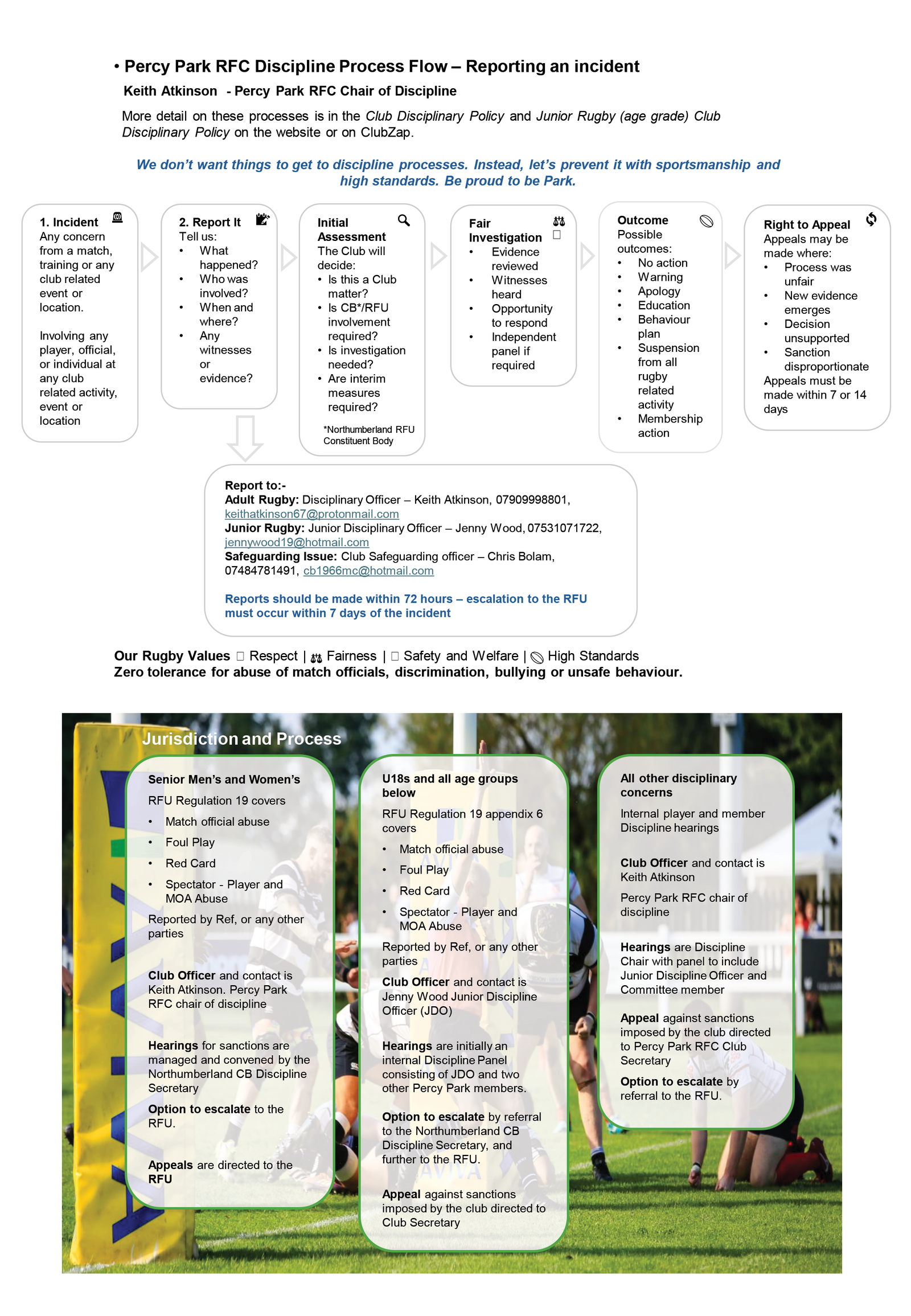
Percy Park RFC Citing Policy
Effective from: 14/09/2026
Review date: 30/08/2027
Policy owner: Club Chair / Club Disciplinary Officer
1. Identify the Incident
Review the match and identify an alleged act of foul play.
- Foul play generally means a breach of Law 9, or certain offences under Laws 3 and 4.
2. Assess the Incident Against the Law
Identify exactly what happened.
- Find the relevant law and determine whether the player's actions could constitute foul play.
- Example:
A dangerous tackle is covered by Law 9.13, with the tackle requirements also set out in Law 14.
3. Apply the "Red Card Test"
Ask:
- "In my opinion, did this act of foul play warrant the player being sent off?"
- The Percy Park Disciplinary Chair can cite a player on behalf of Percy Park RFC when the incident meets this threshold.
4. Consider What the Referee Did
- A player can still be cited even if the referee or assistant referee saw the incident and took action.
- However, there are restrictions where the player has already been sent off, subject to the specific circumstances set out in Regulation 17.
5. Record the Evidence
Consider and retain all relevant evidence, including:
- Match video recording
- Referee and/or assistant referee reports
- Other Video recording
- Photographs
- Witness evidence
- Physio/Hospital injury reports
The evidence should clearly establish what occurred and support the assessment of whether the incident meets the citing threshold.
6. Submit the Citing Complaint
The Percy Park Disciplinary Chair (In their absence the Junior Discipline Secretary) will submit the citing complaint within 7 days of the match in question (ideally within 72 hours)
The case then proceeds to the Northumberland CB disciplinary panel in accordance with the applicable disciplinary process.
7. Disciplinary Hearing
The disciplinary hearing will:
a. Consider the evidence and determine whether the player committed the alleged offence.
b. Determine the applicable sanction using the relevant RFU disciplinary framework.
The Citing Process at a Glance
Incident → Law → Foul Play → Red Card Test → Evidence → Citing → Hearing → Sanction
Important Distinction
Citing is not the same as deciding that a player is guilty.
A citing identifies an incident that may meet the relevant threshold for disciplinary action. The subsequent judicial process considers the evidence and determines the outcome.
The Northumberland CB disciplinary process therefore remains responsible for determining whether an offence has been committed and, where appropriate, what sanction should apply.